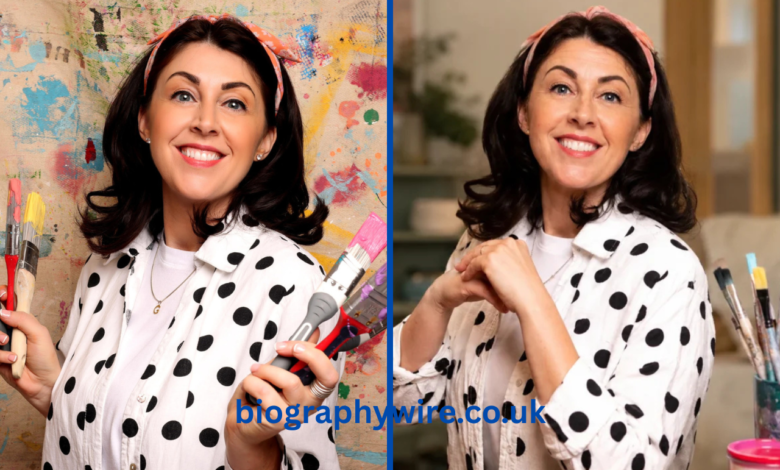
In a world obsessed with perfection and brand-new things, Gemma Longworth stands out as a vibrant beacon of hope, sustainability, and raw, emotional honesty. You might recognize her as the effervescent presenter with the infectious Scouse accent on Channel 4’s Find It, Fix It, Flog It, where she magically transforms discarded junk into stunning furniture masterpieces. But to reduce Gemma to just a “TV presenter” would be to miss the point entirely. She is an art therapist, a social entrepreneur, and a woman who has built an empire of empathy with a glue gun and a paintbrush. What makes her story so compelling isn’t just her eye for design; it is the powerful, heartbreaking motivation behind her mission. She is living proof that creativity isn’t just a hobby—it is a survival mechanism, a way to turn the deepest tragedy into a life of colorful purpose.
| Quick Facts | |
|---|---|
| Full Name | Gemma Longworth |
| Age | 40 (Born May 12, 1985) |
| Profession | TV Presenter, Upcycler, Textile Artist, Author, Entrepreneur |
| Famous For | Find It, Fix It, Flog It (Channel 4), The Button Boutique |
| Birthplace | Anfield, Liverpool, England |
| Family | Brother: Sean (Deceased), Mother: Name not public, Husband: Michael Barker (m. 2019) |
| Net Worth | Estimated $600,000 – $800,000 (2025) |
| Social Media | Instagram: @gemma_longworth_diy, LinkedIn: Gemma Longworth |
The Anfield Roots and The Tragedy That Changed Everything
To understand Gemma Longworth, you have to go back to the streets of Anfield, Liverpool. Growing up in the heart of the city, Gemma was a working-class kid with a typical childhood—until August 8, 1996. On that devastating day, her world was shattered. Her younger brother, Sean, was just eight years old. While playing hide-and-seek with a friend, he hid between two parked cars. Tragically, a car reversed, and Sean was killed instantly .
Gemma was only eleven. In an interview with the Liverpool Echo, she recalled the numbness of that moment, initially thinking her brother would simply have a broken arm, only to wake up the next day to the news that Sean was gone . While her parents sought traditional counseling, Gemma, like many children, struggled to articulate the tsunami of grief flooding her system. She didn’t want to sit in a room and talk to a stranger. Instead, she looked for a way to stay close to Sean.
Sean had been the “artist” of the family. He loved drawing Sonic the Hedgehog and monsters with their granddad. In a beautiful act of remembrance, Gemma picked up the pencils Sean left behind. “I wasn’t great with words, so drawing became my way to remember him,” she explained. “I felt like I was reliving his memory in a way” . This was the accidental birth of her art therapy journey—a quiet, lonely act of keeping her brother’s spirit alive through creativity.
Education and Finding a Voice Through Textiles
As Gemma grew older, her adolescent sketchbook therapy evolved into a serious academic pursuit. She channeled her energy into her studies, attending the City of Liverpool College where she completed an AVCE in Art & Design . She moved on to the University of the West of England in Bristol to earn a BA in Drawing and Applied Arts. Her hunger for knowledge didn’t stop there; she returned to the North West to complete a Master’s degree in Textiles at Manchester Metropolitan University .
Her master’s studies allowed her to dive deep into the tactile world of fabrics, sewing, and mixed media. However, upon graduating in 2008, Gemma faced the harsh reality of the recession-hit job market. There were no galleries knocking on her door. But rather than seeing this as a failure, Gemma did something incredibly brave: she looked back to her childhood for the answer. She returned to Alder Hey Children’s Hospital, not as a patient’s relative this time, but as a volunteer .
Running arts and crafts workshops at Alder Hey, Gemma witnessed firsthand the “so many benefits” of art. She saw anxious children relax and grieving parents exhale as they glued and cut paper. It was here that her professional identity crystallized. She wasn’t just an artist; she was a facilitator of creative wellbeing.
The Button Boutique: Building a Business from Scratch
Recognizing that her workshops had outgrown the hospital setting, Gemma decided to take a leap of faith. With little money but an abundance of grit, she founded The Button Boutique in early 2011 . Her first studio was a modest unit in the Baltic Creative area of Liverpool. “I’ve always been used to not having a lot of money, and having to work with what I’ve got,” she noted. The aesthetic of The Button Boutique came from “white emulsion, lots of fabric, and a fair amount of skip diving” .
What made The Button Boutique different from standard craft stores was the philosophy behind it. Gemma specialized in restoration and vintage craft. She taught people how to darn socks, repurpose old curtains, and sew their own clothes. As her reputation grew, so did the business. By 2014, she had outgrown the Baltic Creative and moved to a larger “hidden gem” of a building on Brick Street . She began partnering with organizations like The Women’s Organisation to master the “boring” stuff—tax, payroll, and business planning—admitting that while the art came naturally, the admin did not .
The Find It, Fix It, Flog It Breakthrough
While Gemma was busy building her creative community in Liverpool, television producers were scouting for talent. They needed someone who wasn’t just a craftsman but a personality—someone who could see the potential in a broken, old dresser while the owner saw firewood. Gemma fit the bill perfectly. She joined the team of Channel 4’s daytime restoration show Find It, Fix It, Flog It.
The premise of the show is simple: experts find forgotten items, fix them up, and flog them for a profit. But Gemma brought a sustainability message to the screen that transcended simple profit. She became known for her wild, colorful, and often unexpected transformations. Whether she was turning a boring beige sideboard into a psychedelic explosion of color or upcycling an old chair with bold textiles, she captivated audiences . Her “Scouse” wit and warm, natural rapport with co-stars like Simon O’Brien made her a fan favorite. She wasn’t just fixing furniture; she was proving that old things still have value—a metaphor that resonates deeply with her own personal history of loss and recovery.
Hidden Gems and Art Therapy Advocacy
Even with the glitz of television, Gemma never forgot her “why.” In 2012, she authored the art therapy book I Need Help. Designed for bereaved children, the book features a bear carrying a rucksack full of stones. As the child works through the activities, the bear removes stones, lifting the weight of grief . Writing the book was a cathartic turning point. “I didn’t realize that I hadn’t grieved properly myself until I started writing it,” she admitted .
This culminated in her most recent and ambitious project: Hidden Gems CIC (Community Interest Company). This social enterprise is the purest expression of Gemma’s life mission. Hidden Gems focuses on creative bereavement support, using upcycling and art to help people process trauma, anxiety, and loss. She has moved beyond just decorating furniture; she uses the act of restoration as a tool for mental health. Whether it is redesigning the Mencap Liverpool café to be a cheerful retreat or running grief workshops, Gemma is redefining what it means to be a designer . Her mantra is simple yet profound: “Turning a negative into a positive no matter what I’m doing” .
Personal Life, Relationships, and Daily Rhythms
Away from the sawdust and paint splatters, Gemma lives a relatively grounded life. In 2019, she married her partner, Michael Barker . While she is open about her past, she tends to keep her current husband largely out of the public eye, preferring to let her work speak for itself. She remains fiercely close to her mother, who is a frequent subject of her social media affection.
Her daily routine is a juggling act. She splits her time between filming, running The Button Boutique, managing the Hidden Gems charity, and teaching workshops. She has spoken openly about the difficulty of switching off, admitting that because the business is “her baby,” she often lies awake thinking about color palettes or funding applications . Her personal style is an extension of her art—vibrant, eclectic, and unapologetically DIY.
Gemma Longworth Net Worth and Income Streams
Estimating the net worth of someone like Gemma is tricky because her wealth isn’t just in cash; it’s in intellectual property and social capital. However, financial estimates place Gemma Longworth’s net worth at approximately $600,000 to $800,000 as of 2025 .
Unlike traditional celebrities, her income is a diversified basket of creative entrepreneurship:
-
Television Salaries: Regular appearances on Find It, Fix It, Flog It provide a stable base.
-
Workshop Fees: She runs numerous paid creative wellbeing workshops and DIY classes.
-
Retail and Studio: Sales from The Button Boutique and commissioned restoration work.
-
Social Enterprise: While Hidden Gems CIC is a community interest company (often reinvesting profits), it provides speaking fees and grants.
-
Book Sales: Royalties from Craft Your Cure and I Need Help .
Social Media Presence and Digital Influence
On Instagram (@gemma_longworth_diy), Gemma continues her mission of zero waste advocacy. Her feed is a cheerful mix of “before and after” shots that would leave any upcycling enthusiast breathless. She shows her followers how to turn trash into treasure, proving that you don’t need a lot of money to have a beautiful home .
Her LinkedIn profile tells a different side of the story—the businesswoman. There, she posts about her entrepreneurial journey, her business clinics, and the development of Hidden Gems . She interacts with her audience with the same authenticity she brings to the screen, often sharing vulnerable moments about the struggle of balancing art and commerce.
Recent Updates and Future Horizons
As of 2025, Gemma shows no signs of slowing down. She has recently expanded her portfolio into children’s television, appearing on CBeebies’ What’s In Your Bag? . She is also deeply involved in community projects, focusing heavily on social regeneration in the Liverpool City Region.
Her primary focus, however, remains Hidden Gems. She is currently working on expanding the reach of her bereavement support network, hoping to bring art therapy to more schools and hospitals across the UK. “This is what I’ve been working towards since I was a child,” she recently posted on LinkedIn, announcing the next phase of her charity work . She is moving away from being just a “Flog It” host and settling fully into her role as a leader in the art therapy and sustainability sectors.
The Legacy of a Creative Healer
Gemma Longworth’s story is not just about making old chairs look cool. It is a masterclass in resilience. When faced with a tragedy that could have defined her negatively, she chose to pick up a brush and draw. She turned the lonely act of grieving into a community movement. In an age of fast fashion and disposable furniture, she teaches us patience. In a world that often tells us to hide our scars, she paints hers neon pink.
As Gemma Longworth continues to pave the way for future generations, her story stands as a reminder of how resilience and purpose can shape a meaningful legacy. She proves that you can be a businesswoman and a healer; that you can be on TV and still be deeply authentic; and that sometimes, the most broken things—whether a rickety table or a grieving heart—have the potential to become the most beautiful works of art.